
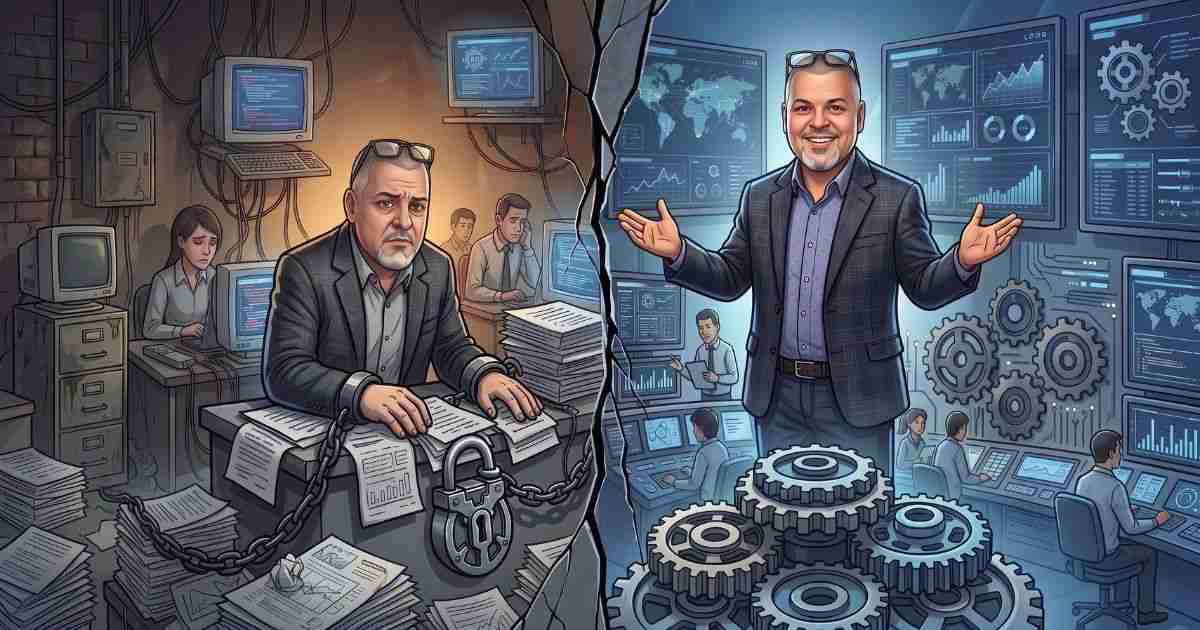
Let me tell you the thing nobody warned me about.
Your business is a mirror. It grows to the size of the identity running it, then it stops. Not because you ran out of market. Not because you ran out of hustle. Because the business quietly outgrew the version of you leading it, and that version became the ceiling.
You can feel it before you can name it. You finally get a little quiet, and instead of resting, you’re bracing, because you already know how it goes the second you unplug.
The proposal nobody can send but you. The client only you can calm down. The decision three people are stuck on… and all three of them are stuck on you.
You built this thing. And somewhere along the way, it started running you.
Sound familiar?
Then hear me on this, before we go any further. I’ve stood right about where you’re standing now. Maybe not the same details, but the same trap. I know the weight of it. And I know the way out.
For over twenty years, I’ve been in the trenches with service-business owners. But I’ve been around business a lot longer than that.
I walked into my own business sure I was covered. The MBA. A dozen years in corporate America running multimillion-dollar IT projects around the globe. I was holding the playbook they hand you: delegate, tighten your systems, work on the business, not in it.
That playbook nearly buried me. Because here’s what no professor ever said out loud: it trains you to be a world-class operator. It makes you the best, hardest-working employee in a company that happens to have your name on the door. Nobody hands you the one that turns you into something else.
I found that out the hard way. When I struck out on my own, I got my rear end kicked. Everywhere. A couple of my companies failed outright before Online Marketing Muscle ever got off the ground in 2004.
I had all the degrees. I thought I was the smartest guy in the room. And none of it saved me, because I didn’t know what I didn’t know.
Took me years, and more money than I want to admit, to find the real problem. It wasn’t the market. It wasn’t the economy. It wasn’t the one more tactic I hadn’t learned yet.
It was me. I was the bottleneck.
That’s the part nobody wants to hear, so let me say it clearly, and I say it with love: the operator mindset that got you here is exactly what won’t get you there. And now, with AI rewriting how business gets done at breakneck speed, that mindset isn’t just holding you back anymore.
It’s putting a clock on you.
The difference between owners who stay stuck and those who finally build something that outgrows them has a name. I call it Orchestrator Leadership. And by the end of this, you’re going to know exactly which side of that line you’re standing on, and how to cross it.
The choice, like always, is YOURS.
Inside This Article
- The Leadership Crisis No One’s Talking About
- Hustle Culture: The Air You’re Breathing
- The Three Operator Identities
- Glass Ceilings and the Owner’s Prison
- What Orchestrator Leadership Actually Looks Like
- The Owner’s Evolution Ladder
- Evolve to Actualization
- Why AI Makes This Do-or-Die
- The Clone the Owner® Approach to Leadership Evolution
- The Owners Who Will Dominate
- The Choice Is Yours
The Leadership Crisis No One’s Talking About
Here’s what conventional leadership development won’t tell you.
Most of it is teaching you to become a more sophisticated prisoner.
Better time management. Smarter delegation. Tighter systems. All useful. And all of it treating the symptom while the disease keeps spreading.
Because that revenue plateau? It’s a symptom. It was never the real problem. When an owner stalls at $800K, or can’t crack $3 million, or gets stuck at $5 million, the number was never the issue.
The number is just the smoke. The fire underneath is almost always the same thing: the business has quietly outgrown the way its owner leads it.
Let me say it as plainly as I can. In over twenty years of coaching owners, I have never once seen a service business break the $3 million barrier on operator leadership.
Not one.
Same Recipe, Two Owners, One Difference
Want the proof? Here’s the proof.
Picture me handing two owners the exact same playbook to get to $5 million. Same steps. Same systems. Same recipe, same ingredients, same everything.
One of them gets there.
The other one crashes and burns.
So what’s the variable? It was never the recipe. It’s the leader.
When you started out, you had to be great at the work. You delivered it, you solved every problem, you made every call. That was right. That’s exactly what the early game demanded of you.
But if you’re still doing all of that today? You’re not leading. You’re operating at a higher salary.
And if the whole thing seizes up the second you step away, let’s be honest with each other about what you’ve actually built. Not a business. A very expensive job with unlimited overtime and a boss who never lets you quit.
I say that with love… because I built one of those too.
Hustle Culture: The Air You’re Breathing
Before we name the thing that traps you, we have to name the thing that builds the trap.
We live in a hustle culture. Grind harder. Wake up earlier. Out-work everybody in the room. It’s the water we’re all swimming in, and most owners never think to question it, because it’s just… the air.
Here’s the problem with the air.
Hustle culture doesn’t just make you tired. It quietly manufactures the exact identities that keep you stuck. It whispers a very convincing lie: if the business needs more, the answer is more of you. More hours. More decisions. More of you at the center of everything.
I’ve been preaching this one for twenty years, so let me say it loud for the folks in the back.
Busyness does not equal business. Motion is not progress.
And the harder you hustle inside the wrong role, the more permanent your ceiling gets.
So the real question isn’t whether you’re working hard. I already know you are. That was never in doubt.
The real question is who hustle culture has quietly turned you into.
The Three Operator Identities
Let me introduce you to three characters. Watch closely. You might see yourself in one of them. You might see yourself in all three.
I’ve watched these three identities keep sharp, capable owners stuck long after they knew, deep down, that something had to change.
And here’s the part that matters most. Nobody handed these roles to you. You cast yourself in them. That’s not an accusation, so don’t hear it as one. It might actually be the best news in this whole article.
Because a role you gave yourself is a role you can take back.
 Most stuck owners are playing one of three roles they cast themselves in: the Expert, the Controller, or the Hero. Naming yours is the first step to handing it back.
The Expert
“No one can do it as well as I can.”
Maybe you know this one from the inside. You got so good at the work that it’s hard to picture anyone else touching it. It’s faster just to do it yourself. Nobody knows the clients the way you do, and you can’t afford to get it wrong.
If any of that lands, I get it. That expertise is real, and you earned it.
But here’s what can happen while you’re not looking. That expertise quietly becomes your ceiling. Everything in the business starts squeezing through the one person who can’t be cloned.
You.
The Controller
“If I’m not in every decision, it all falls apart.”
This one’s sneaky. If it’s yours, being in the middle of everything feels like control. Feels responsible, even.
But here’s what may be happening underneath. Every personal decision you make is one your team just learned they’re not allowed to make without you. It can look like you’re building control.
When really, you might be building dependency and calling it standards.
The Hero
“They need me to swoop in and save the day.”
This might be the most seductive of the three. If you recognize it, you know the pull. Being the one with the answers. The one everybody runs to. The one who rides in and rescues the deal, the project, the fire about to burn the whole thing down.
It feels important. It feels valuable. And I won’t pretend it doesn’t feel good, because it does.
But it isn’t leadership. It’s ego management. And a business that needs a hero on call is a business with one single point of failure.
And if that’s the seat you’re in… that point is you.
Now read those three again. See it? They’re the same knot, tied three different ways. I do it best. I have to decide it all. I have to save the day.
That knot is what builds your glass ceilings, one story at a time. And whichever of these you handed yourself, that’s exactly the one you get to hand back.
Glass Ceilings and the Owner’s Prison
Every one of those identities builds a wall. And the walls talk to you. Not good enough. Don’t have what it takes. If I could just learn one more thing, I’d finally break through.
Those walls are glass ceilings. And here’s their cruelest little trick: because you built them yourself, you usually can’t even see them. They’re self-imposed.
Which is the exact reason they can be shattered.
Stack enough of them up, though, and they become something bigger than a ceiling. They become a cage. A successful, respectable, profitable business that quietly owns you.
I call it the Owner’s Prison. And the bars? The bars are the glass ceilings you installed yourself.
Here’s what makes this prison so hard to walk out of. For many owners, it isn’t even a bad business. It’s a good one. Something real, something people respect, something you poured yourself into.
And somewhere along the way, it quietly became a very expensive place to be stuck.
So let’s talk about the way out. Because there is one. And it starts with the one shift almost nobody makes.
What Orchestrator Leadership Actually Looks Like
So what is orchestrator leadership, really?
Simple. You stop playing every instrument. You pick up the baton, and you conduct.
Picture the operator as the one musician trying to carry the whole song alone. Head down, holding the beat, playing louder and faster to cover for every empty chair. The second that musician stops, the music stops with them. That’s most owners. The most talented player in the room, and the exact reason the room goes silent the moment they step out.
The orchestrator does something that looks, at first, like doing less. They lower their own instrument. They walk to the front of the room. And they get the entire ensemble playing in perfect time without touching a single note.
Now here’s where most leadership advice gets it dead wrong. They think orchestration is just a fancy word for delegation. It’s not.
Delegation is handing off tasks. Orchestration is building an organization that makes the music whether or not you’re holding the baton.
That’s the whole ballgame. It’s the difference between a business that leans on you and a business designed to think, decide, and perform without you in the room.
It’s the leadership evolution that separates the six-figure grinder from the eight-figure builder.
The Mindset Shift
 Operator or orchestrator was never about working harder. It’s four shifts in who you’re being, starting with going from making every decision to designing how decisions get made.
It comes down to four shifts in who you’re being.
1. From Decision Maker → to Decision Designer
You stop making every call, and you start building the frameworks that let your team make great calls without you.
2. From Problem Solver → to Problem Preventer
You stop being the hero who fixes the fire, and you start building the systems that keep the fire from starting.
3. From Knowledge Keeper → to Knowledge Orchestrator
You stop being the walking hard drive, and you start building systems that pull what you know out of your head and put it in everyone’s hands.
4. From Team Manager → to Team Architect
You stop managing what your people do all day, and you start designing the environment where they do their best work on their own.
Read that list one more time. Notice that none of those shifts are about working harder. Every single one is about becoming somebody different.
The Owner’s Evolution Ladder
Here’s the part almost nobody tells you, and I really wish somebody had told me sooner.
Every level of business is a completely different job.
Running a $5 million company is not a bigger version of running a $1 million company. It’s a different job. Running $1 million is a different job than running $300K. Running $10 million is a different job than running $5 million.
Different systems. Different team. Different hierarchy. Different you.
I think of it as a ladder. Each rung is a level of scale, and each rung demands a different version of the leader standing on it.
Below a million, operator leadership can still work. Barely. Between one and three million, it becomes the single biggest thing holding you back. Above three million, it’s flat-out impossible.
That’s not a knock on you or anybody. It’s just math. There are only so many hours in a day, and there’s only one of you.
So at every rung, you face the same two honest choices. Evolve into the leader that level requires… or make the harder, braver call and put someone in that seat who already is.
Both are honest. Both work.
The one thing that never works is standing on a higher rung with a lower rung’s version of yourself. That’s how people fall.
This is the climb. I call it the Owner’s Evolution Ladder, and learning to climb it is the whole game.
Evolve to Actualization
I wrote a line in my book, The MINDstretch, that sits underneath every word I’ve said so far:
“You either evolve to actualization, or you spend your energy defending who you already were.”
That’s the deepest truth I know about scaling a business. And here’s the strange part… it has almost nothing to do with business.
The identity that built your company is not always the identity that can grow it. The gritty operator who got it off the ground. The expert who won every ounce of trust by being the best in the room. The founder who made every call because everything depended on it.
Those aren’t flaws. Hear me on that. Those were exactly what the early game required of you.
But at some point, the business turns around and asks you a much harder question. Who am I still trying to be that this company has already outgrown?
Answering that honestly is the single hardest, most important move an owner will ever make. Because you’re not releasing a tactic. You’re releasing a version of yourself you’re genuinely proud of.
I know exactly how heavy that is. I spent years white-knuckling my own MBA-trained certainty long after reality had stopped agreeing with me.
That inner work, the discipline of seeing clearly and letting go of a label that’s gone stale, is a skill all its own. I went deep on it in The Adjustment Gap, if you want the version that took me three books and a whole lot of getting out of my own way to finally understand. (The MINDstretch lives here on my site, and on Amazon if you’d rather grab it there.)
Evolve to actualization. That’s the real name of the work hiding underneath “operator to orchestrator.”
Why AI Makes This Do-or-Die
Now let me tell you what most owners are getting completely wrong about AI. Because this is the part that turns a someday problem into a right-now one.
AI does not replace leadership. It amplifies the gap between great leaders and average ones.
Average leaders are using AI to do their current job a little faster. Great leaders are using it to do a completely different job. And that different job… is orchestration.
Which means AI is about to make the operator trap brutally, publicly obvious. It doesn’t make weak leadership efficient. It exposes it. Faster than ever, right in front of your best people and your most important clients.
Because AI amplifies whatever you feed it. Feed it order, it multiplies order. Feed it a business that runs entirely through one exhausted human, and all it does is show everybody, sooner, exactly where the ceiling sits.
And let me be crystal clear about one thing, because most of the industry is selling you the exact opposite. AI is not the solution. You are. AI amplifies. It does not absolve. It’s the most powerful lever any of us has ever been handed, but a lever still needs a hand on it and solid ground to stand on.
Now, I know how a big prediction lands, especially from some guy you’ve never met. So let me earn it first.
Back in 2004, I bet on the internet. I started an online marketing company, and people I respected laughed in my face. “The internet’s a fad. You’ve got a master’s degree, and you’re betting the farm on this?” I took the lumps, and I kept going, because I could see where the puck was heading.
Who’s laughing now?
I’m not telling you that to brag. I tell you because I’ve called this exact kind of shift before, back when it was unpopular to say out loud. So hear me on the next one.
Here’s my prediction, and I’ve been on record with it for years.
By 2030, most operator-dependent businesses will either be extinct or acquisition targets for the ones who figured out orchestration.
In the Intelligence Age, businesses that fail to evolve will cease to exist. That’s not doom talking. That’s just the math of the moment we’re all standing in.
The Clone the Owner® Approach to Leadership Evolution

So how do you actually make the climb? You don’t wing it. You follow a path.
I’ve spent the last two decades building the Clone the Owner® Methodology for exactly this transition, and it rests on six pillars: Vision, Team, Systems, Controls, Technology, and Mindset.
But here’s what I learned the hard way, after watching hundreds of owners try to change all at once and burn out. You can’t work on all six at the same time. The methodology has a sequence. And it starts with Vision.
Not a mission statement gathering dust on a wall. Real vision architecture, the kind that guides the decisions your people make when you’re nowhere in the room. Until you’re crystal clear on exactly where you’re going and why it matters, nobody can lead toward it.
Neither can any AI, by the way. Point a machine at a fuzzy vision, and it’ll just help you get lost faster.
Then we make it real, ninety days at a time. Not five-year fantasies. Ninety days is long enough to genuinely rewire how the business runs, and short enough that you can’t hide from the results.
Every 90-day Sprint runs the same rhythm.
First, you plan. You pick the two or three leadership shifts that will move the needle most, you get honest about what “done” actually looks like, and you decide who owns what. No vague resolutions. Real targets.
Then you run it. You spend the heart of the quarter doing the actual work, you meet every week to stay accountable, and you adjust as reality talks back. Because it always does.
Then you reflect. You stop and look at what changed, what didn’t, and what you’re carrying into the next ninety days. Then you climb the next rung and do it again.
That’s it. That’s the climb, one rung at a time.
The Owners Who Will Dominate
Yesterday’s operator is tomorrow’s extinction story. The next decade belongs to the orchestrators.
Call it the shift. Operator on one side, orchestrator on the other. The Information Age on its way out, the Intelligence Age barreling in.
Let me paint you two pictures. Same industry. Same starting line. It’s 2030.
 The operator lives in the Information Age, buried in the work. The orchestrator steps into the Intelligence Age and leads the machine. Same person, different identity.
The Operator in 2030
If the business is even still standing.
Here’s the reality I’m watching pick up speed. The businesses that can’t evolve past the owner-dependent model won’t make it through the next three years, let alone five.
He’s still trying to oversee everything personally. Meanwhile, his competitors built AI-augmented teams that deliver better work, faster and cheaper than he ever could on his own.
His best people? Long gone. They left for companies that actually let them decide things and grow.
His clients? Also gone. They moved to providers who don’t hinge on one human being’s availability.
He won’t just be struggling. He’ll be extinct.
And here’s what finishes it off…
The next economic downturn will be the great operator extinction event. Only the orchestrator-led businesses will have the agility and the resilience to ride it out.
The Orchestrator in 2030
Now the other picture.
She’s working on the business, not buried inside it. She leads a team that makes exceptional calls without her hovering over every one. She’s using AI as a force multiplier stacked on top of a business that already runs clean.
Her company runs like a symphony. Every part in time, all of it moving toward one shared Vision.
She’s not just successful. She’s free.
And she’s the one writing the checks… buying up the operator businesses that didn’t make it, for pennies on the dollar.
Here’s the part that should keep you up tonight. This isn’t 2030 talking. It’s already happening.
Orchestrator-led businesses are growing faster, attracting better people, and commanding premium prices, all while asking less and less of their owners.
Operator-led businesses are white-knuckling their talent, chasing clients, and watching their margins thin, all while demanding more and more of theirs.
The gap between them is widening. Fast. And AI is the accelerant.
This isn’t speculation. It’s an extrapolation from what I’m already seeing up close with my own clients.
So which picture is you? Not today. In 2030. Because the version of you reading this right now is the one who gets to decide.
The Choice Is Yours
Here’s the honest truth about all of it. Most owners will read something like this, nod along, and recognize they need to change.
Very few will do the actual work.
The window is closing faster than it looks from where you’re sitting. The owners who will own the next decade are the ones who start evolving now. Not next quarter. Not when things finally calm down, because they won’t. Not when AI “matures.” Now.
Because this was never really about AI, or systems, or even scale. It’s about one question. Are you willing to become the person your business needs you to be next?
And then to keep becoming that person, at every single rung of the ladder?
Your business will only ever grow to the degree that you do.
I’ve watched that truth play out a few thousand times now. It has never once been wrong.
So here’s the real question. It isn’t whether you can make the shift from operator to orchestrator. I’ve watched people with a whole lot less going for them pull it off.
It’s whether you’ll make it while it’s still your choice to make… or wait until the market makes it for you.
Let me tell you about the moment it turned for me.
Years back, I was running three businesses at once. Running all three of them badly, if I’m being honest with you. I had a coach at the time, and she looked me dead in the eye and said: pick the one you believe in most, shelve the other two for a year, and pour everything into that one.
Every New York bone in me wanted to fight her. Who was she to tell me what to do?
But she’d already been where I wanted to go. So I shut up, and I listened. The one I kept was Online Marketing Muscle. Over twenty years later, I’m still here.
I did not get out of my own way on my own. Nobody does. That’s the entire point of a guide.
That’s the work I do with a small number of owners each year. Not because I’ve got all the answers, but because sometimes you need somebody who’s already made the climb to point at the thing you can’t see yet.
The first move, though? That doesn’t cost a thing. And it was never mine to make.
It’s yours. #EvolveToOrchestrator
P.S. The next five years will separate the operators from the orchestrators. Cleanly. Permanently. The question was never whether you can make this transition. You can. It’s whether you will, and whether you’ll start, while starting is still up to you.

2 Responses
As a Transformational Coach supporting people with their growth in the varying changes, challenges and chapters of their lives it will be a great to learn how we can all implement AI to make our goals more in alignment and have quicker results with the benefit of all involved in the process of creating an incredible and trusting work atmosphere where people can be happy with their work and proud of their part in the creation of a multifaceted plans/projects all unique to the client to help them excel as they desire.
Very interesting! I look forward to learning more about this.
Thanks so much for your comment! It’s great to hear how excited you are about using AI to help people grow, set goals, and build trust in their work.
You’re right, AI can be a huge help for coaches like you! It ties in perfectly with the idea of “Orchestrator Leadership” – using smart tools to make things flow better and help your clients achieve amazing things.